


76% of revenue teams say their biggest bottleneck isn't lead volume it's lead quality and routing
The scene plays out the same way in boardrooms across the country. A sales team runs a webinar, posts on LinkedIn, launches a cold campaign, and watches the leads pour in. Then the questions start. Who touched this prospect last? Which channel brought them in? Why did this deal go dark after the first email? Somewhere between capture and conversion, the pipeline develops a blind spot. Leads scatter across forms, chat widgets, email threads, and spreadsheets. The volume looks healthy. The revenue doesn't follow.
This is the problem that modern B2B lead generation systems are designed to solve not by generating more leads, but by building the infrastructure to capture, score, and route every prospect at the volume a pipeline actually demands. The shift is tactical: from measuring how many leads come in to measuring how many move through a defined journey from first click to closed deal.
For revenue teams researching how to build this kind of system, the landscape can feel overwhelming. There are tools for data extraction, email sequencing, chatbot deployment, lead enrichment, and more each promising to solve a piece of the puzzle. The question isn't whether to adopt automation. It's how to connect those tools into a coherent pipeline that sales teams actually trust and use.
What a B2B Lead Generation System Actually Is
A B2B lead generation system is not a single tool. It's a connected infrastructure that manages the full lifecycle of a prospect from the moment they first interact with a brand to the moment they hand off to a sales rep as a qualified opportunity. According to the BulkLeads lead generation overview, the goal is to build systems that capture, score, and route leads at the volume a pipeline demands, with full source attribution at every touchpoint.
The core components of this infrastructure typically include inbound capture mechanisms, outbound scaling tools, lead qualification logic, and conversion path mapping. Inbound capture routes every form fill, chat interaction, and social touchpoint into one unified pipeline. Outbound tools such as email sequences and data extraction scale outreach without sacrificing deliverability. Lead qualification ensures that only sales-ready prospects enter the pipeline, filtering out noise. Conversion path mapping turns scattered touchpoints into a measurable journey from first click to closed deal.
The key word is system. A collection of point solutions that don't talk to each other isn't a system it's a stack. What makes a lead generation system effective is the integration layer that connects capture to scoring to routing to CRM, so that every team member knows exactly where a lead came from, where it is in the funnel, and what action to take next.
How B2B Data Decay Changes the Math
Before building a lead generation system, it's worth understanding why data quality is the load-bearing wall of the entire infrastructure. B2B contact data decays between 30 and 70 percent per year, according to UpLead's 2026 guide on buying B2B leads. That means a list purchased or built today could be between 30 and 70 percent inaccurate within twelve months. Contacts change jobs, email addresses become inactive, phone numbers get disconnected, and firmographic data company size, revenue, industry shifts as organizations evolve.
This decay rate has direct implications for how revenue teams should design their lead generation infrastructure. Real-time verification isn't a nice-to-have feature it's a baseline requirement. Any system that relies on static contact lists without a mechanism for continuous validation is building on a deteriorating foundation. The most effective lead generation platforms now integrate email verification APIs, intent signal monitoring, and automatic data enrichment to keep contact records current as prospects move through the buying journey.
For teams that buy leads rather than build them organically, the decay rate also affects how they should approach vendor selection. UpLead's research notes that high-quality leads meet four criteria: accuracy (real-time verified), intent (active buying signals), fit (matches your ideal customer profile), and recency. A lead that was accurate eighteen months ago but hasn't been refreshed since is a lead that may no longer represent a real buying opportunity.
The Ten-Tool Stack: What Modern Lead Generation Platforms Offer
One of the most significant shifts in the lead generation landscape over the past several years has been the consolidation of previously fragmented tools into unified platforms. Rather than subscribing to a separate data provider, email sequencing tool, chatbot service, and review management system each with its own onboarding, pricing structure, and integration requirements revenue teams can now access a suite of AI-powered tools under a single plan.
According to BulkLeads.net's product overview, the platform offers ten AI-powered tools designed to work together: Data Extractor, Email Sequences, Email Finder, Email Verifier API, B2B Social Leads, Lead Enrichment, New Leads Daily, Review Management, Social Proof Widget, and Chatbot AI. Each tool addresses a specific stage of the lead lifecycle, and the platform is designed so that data flows from one tool to the next without manual re-entry.
The Data Extractor pulls contact information emails, phone numbers, social media URLs from a list of websites and exports the results as a downloadable spreadsheet. The Email Finder takes a first name, last name, and company name (or domain) and returns a deliverable business email address, using pattern recognition to construct email formats like first.last@company.com. The Email Verifier API blocks fake and disposable emails at the point of signup, preventing low-quality contacts from entering the pipeline from the start.
The Chatbot AI captures and qualifies visitors automatically, collecting contact information and routing it via email, SMS, or directly into a Slack channel. The Social Proof Widget displays notification badges that show recent customer activity, building trust signals on landing pages. Review Management automates the process of sending satisfied customers to Google, Yelp, and Facebook, strengthening local credibility without manual follow-up.
For outbound teams, Email Sequences runs cadence-based campaigns on the user's own SMTP server, tracking every reply and managing follow-up timing across multiple touchpoints. New Leads Daily delivers fresh B2B contact records every morning, giving sales teams a head start before competitors can reach the same prospects. Lead Enrichment fills in missing firmographic data company size, revenue range, industry classification so that scoring models have the context they need to route prospects correctly.
Building the Pipeline: From Scattered Forms to Structured Flow
The most common failure mode in B2B lead generation isn't a lack of tools it's a lack of structure. Teams invest in chatbots, email sequences, and data enrichment platforms, but those tools operate in silos. A chatbot captures a visitor's information but doesn't automatically score them. An email sequence sends a follow-up but doesn't update the CRM record. A data enrichment run fills in missing fields but doesn't trigger a routing action.
Building a lead generation system that actually fills the pipeline requires designing the flow before building the stack. The sequence looks like this: capture every inbound touchpoint in one pipeline with full source attribution; score each prospect against a defined ideal customer profile; route qualified leads to the appropriate sales rep or sequence; and track the journey from first click to closed deal through a measurable attribution model.
The BulkLeads.info platform overview describes this as a structured lead pipeline where every prospect is scored, routed, and handed off without the sales team asking where a lead came from. That last part is the operational detail that separates a functioning system from a chaotic one. When a sales rep picks up the phone to follow up with a prospect, they should know immediately which campaign brought that person in, what content they engaged with, how many touchpoints preceded the conversion, and what the next best action is based on the prospect's behavior profile.
Without that attribution layer, sales teams spend time reconstructing context instead of having conversations. They guess. They re-ask questions the prospect has already answered in a form or chatbot interaction. They send emails that duplicate previous outreach. The pipeline looks active, but the team is working harder than they need to.
Automating B2B Lead Generation Without Losing the Human Signal
Automation is the engine of scale in modern lead generation systems, but it's also where teams lose the thread. The promise of AI-powered chatbots and automated email sequences is seductive: capture leads while you sleep, run fifty-touchpoint cadences without lifting a finger, and let the machine handle the follow-up that reps never get to. The reality is more nuanced. Automation handles volume. Humans handle nuance.
The most effective lead generation systems automate the administrative layer data capture, email verification, routing, scoring, and follow-up timing while preserving human involvement at the qualification and conversion stages. A chatbot can collect a visitor's name, company, budget range, and timeline. It can score that prospect against an ICP and route them to the appropriate sequence. But when a high-value prospect asks a nuanced question about pricing, implementation timeline, or technical integration, the chatbot should hand off to a human not try to answer with a pre-written script.
The key design principle is to let automation do what automation does best: process high volumes of routine interactions consistently, maintain data hygiene across the pipeline, and ensure that no prospect falls through the cracks due to a rep's busy calendar. Humans do what humans do best: build trust through conversation, navigate complex objections, and close deals that require relationship intelligence beyond what a scoring model can capture.
UpLead's research on buying leads reinforces this principle. Their guide recommends running at least five touchpoints before marking a contact cold a cadence that would be nearly impossible to manage manually at scale. The five-touchpoint rule is an automation-friendly guideline: it can be built into an email sequence, tracked in a CRM, and reported on as a pipeline metric. But the content of those touchpoints the messaging, the personalization, the objection handling still requires human craft.
What Effective B2B Lead Generation Actually Costs
One of the most common questions revenue teams ask before building a lead generation system is how much it will cost. The honest answer is that costs vary significantly based on the scale of the operation, the tools selected, and the level of data quality required. UpLead's 2026 guide notes that self-serve lead platforms range from $19 to $99 per month for entry-level plans, while enterprise-grade tools can run $15,000 or more per year. Most platforms offer free trials so teams can validate data quality before committing to a paid plan.
For teams evaluating lead generation platforms, the cost-per-lead metric is less useful than the cost-per-qualified-opportunity metric. A platform that delivers 1,000 raw leads at $2 each is more expensive than a platform that delivers 100 qualified leads at $20 each because the 100 qualified leads require far less sales team filtering, re-qualification, and dead-end outreach. The true cost of a lead generation system includes not just the platform subscription, but the time sales reps spend filtering low-quality leads, the revenue lost to slow follow-up on prospects who were ready to buy, and the opportunity cost of building pipeline at a slower rate than competitors.
BulkLeads offers a tiered pricing structure with plans that include unlimited access to all ten AI-powered tools under a single subscription. The platform emphasizes that there are no contracts and no long-term commitments required a design choice that reflects the reality that lead generation needs evolve as markets shift, ICPs change, and sales cycles compress or extend. Teams that want to test the infrastructure before committing can start with a free version and upgrade as pipeline demands grow.
The Compliance Framework: Legal Requirements for Buying and Using Leads
For teams that supplement organic lead generation with purchased contact data, understanding the compliance landscape is essential. Buying leads is legal in the United States and internationally, but only when the data provider complies with applicable regulations. UpLead's guide lists four key frameworks: GDPR for European Union contacts, CCPA for California residents, TCPA for US phone-based outreach, and CAN-SPAM for US email campaigns.
GDPR (General Data Protection Regulation) requires that any contact record collected from EU residents include explicit consent for marketing outreach, and it gives those contacts the right to request deletion of their data at any time. CCPA (California Consumer Privacy Act) similarly grants California residents rights over how their data is collected, stored, and used. TCPA (Telephone Consumer Protection Act) governs how sales teams can use automated dialing systems and pre-recorded messages for phone outreach violations can result in statutory damages of $500 to $1,500 per call or text. CAN-SPAM sets rules for commercial email, including requirements for opt-out mechanisms, accurate sender identification, and clear subject lines.
The practical implication for revenue teams is that they cannot simply import a purchased list and start emailing or calling without verifying that the data provider has obtained compliant consent from each contact. Reputable lead platforms conduct their own compliance audits and provide documentation upon request. Teams should request that documentation before purchasing a list, particularly for outreach targeting EU residents or California contacts.
Why This Matters for BulkLeads Readers
For readers researching how to build a scalable lead generation infrastructure, the core insight is that the system matters more than the individual tools. A chatbot alone doesn't build pipeline. An email sequence alone doesn't qualify prospects. The value emerges when those tools are connected through a structured pipeline that scores, routes, and attributes every touchpoint so that sales teams spend their time selling instead of reconstructing context.
The data decay rates 30 to 70 percent per year underscore why real-time verification and continuous enrichment are non-negotiable components of any modern system. Static lists are a depreciating asset. The teams that maintain pipeline velocity are the ones that invest in infrastructure that keeps contact data current, routes prospects automatically, and surfaces attribution insights that help reps have smarter conversations.
For teams evaluating whether to build internally or buy a platform, the cost comparison should focus on qualified-opportunity cost rather than raw lead volume. The tools described in this article data extraction, email sequencing, chatbot deployment, lead enrichment, review management are available individually or as integrated suites. The decision framework should start with pipeline requirements and work backward to tool selection, not the other way around.
Comparing Lead Generation Platforms: Key Criteria
When evaluating lead generation platforms, revenue teams should assess five core criteria: data accuracy and verification methodology, ICP fit and segmentation options, compliance documentation, integration depth with existing CRM and sales tools, and pricing structure relative to pipeline volume. The table below summarizes how three leading platforms compare across these dimensions.
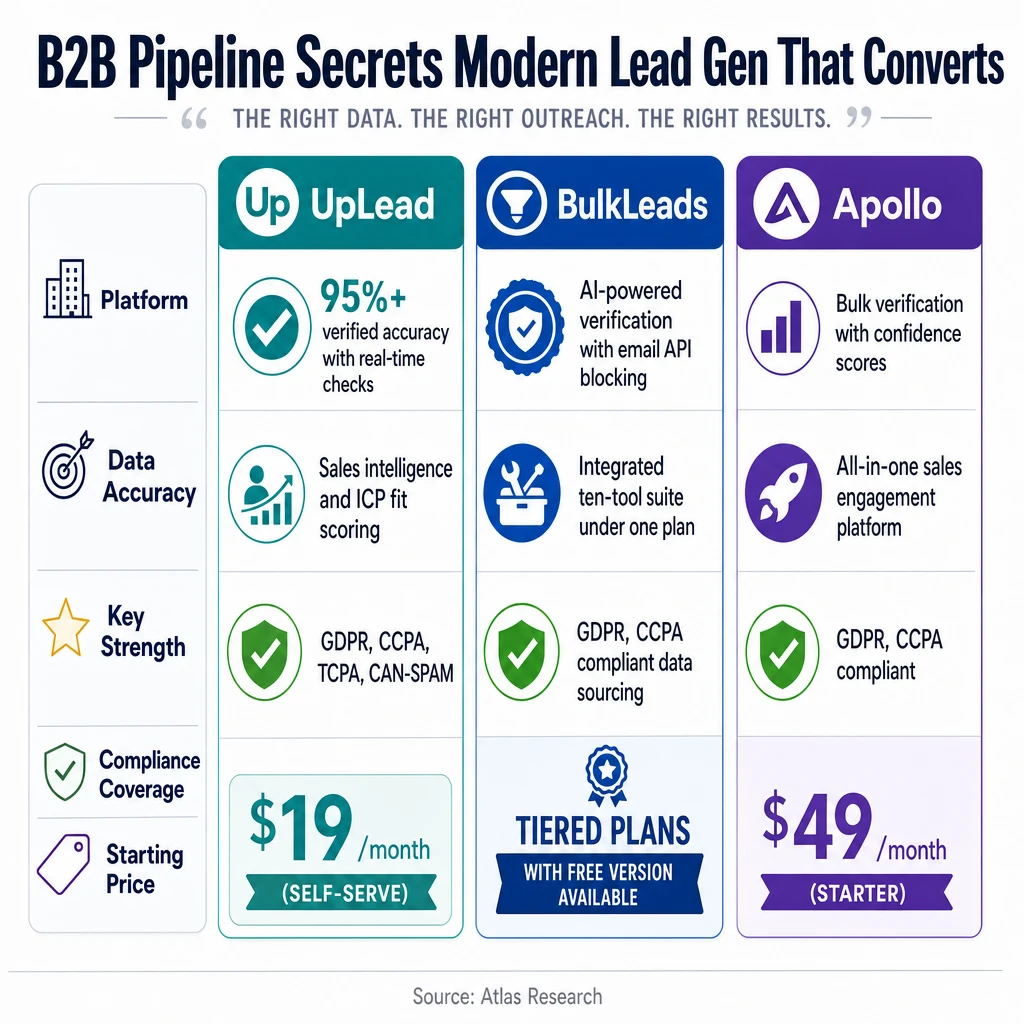
| Platform | Data Accuracy | Key Strength | Compliance Coverage | Starting Price |
|---|---|---|---|---|
| UpLead | 95%+ verified accuracy with real-time checks | Sales intelligence and ICP fit scoring | GDPR, CCPA, TCPA, CAN-SPAM | $19/month (self-serve) |
| BulkLeads | AI-powered verification with email API blocking | Integrated ten-tool suite under one plan | GDPR, CCPA compliant data sourcing | Tiered plans with free version available |
| Apollo | Bulk verification with confidence scores | All-in-one sales engagement platform | GDPR, CCPA compliant | $49/month (starter) |
This comparison is not exhaustive and reflects publicly available pricing as of mid-2026. Teams should verify current rates and feature availability directly with each platform before making a purchasing decision.
Where to Read Further
For readers who want to go deeper on specific components of B2B lead generation systems, the following resources offer detailed guidance on platform selection, compliance requirements, and pipeline architecture. The UpLead guide on buying B2B leads provides a structured framework for evaluating data providers, understanding compliance obligations, and running effective post-purchase follow-up sequences. The BulkLeads lead generation overview covers the full pipeline architecture from inbound capture to conversion path mapping. The BulkLeads.net product suite page details the ten AI-powered tools available under the platform and how they integrate with each other.
Building a lead generation system that actually fills the pipeline is a multi-quarter project, not a one-time tool purchase. The teams that get it right are the ones that start with the pipeline architecture, define the scoring and routing logic, and then select tools that fit that design rather than buying tools first and trying to retrofit a system around them. The infrastructure exists. The question is how to connect it.